Role of Hypermobility in TMJ
Many of our TMJ patients we see in our practice have hypermobility of their ligaments. Some of the patients have had injuries directly to the ligaments of the jaw joint, such as a stretch injury from having wisdom teeth removed. Other patients have had ligament injuries from a dramatic wipeout, like the ski accident Dr C herself had! But most of the patients we see with ligament laxity in the TMJ jaw joint have a more generalized condition of hypermobility in the whole body. Some have been diagnosed with hEDS (Ehlers-Danlos Syndrome, hypermobility type).
The Big Picture
The correlation makes sense once we explain it this way: as the only truly bipedal creatures on earth, walking is a series of falling and catching. There are stretch receptors in our tendons and ligaments that tell us when to transition our weight to the next foot. When those stretch receptors are less accurate in the relay to the brain (as in a person with hypermobility), the skeletal muscles have to do more work in compensation. As a result, they keep the person upright and balanced.
While most of our stability should come from the lower half of our body and while most of our flexibility should be in our upper half, people with generalized hypermobility are “wobbly” in the ankles/knees/hips. As a result, they compensate by recruiting muscular tension up the kinetic chain into the head and neck for balance. That extra tension often includes clenching the teeth, shrugging the shoulders, and bracing the neck and jaw. And this often happens more on one side of the body than another.
Design of Splint
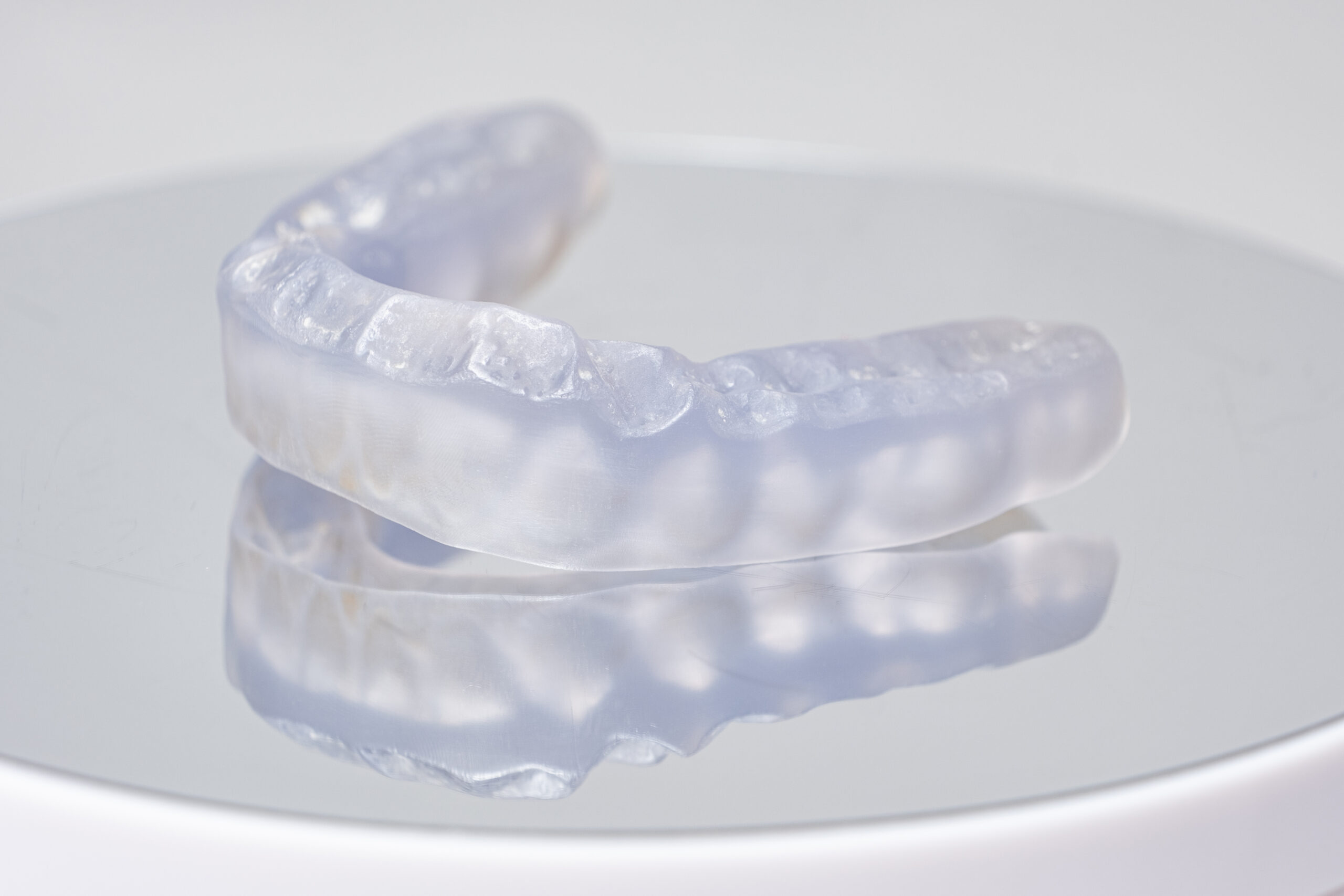
The initial design of a lower bite splint for hypermobility will have little indentations into which the upper teeth cusps rest (see image below). This design provides lateral support for the jaw and a much greater degree of proprioception about where the jaw is in space. Ideally, a patient with hypermobility would work with a physical therapist educated in functional asymmetry and movement patterns. In our office, we call that Integrative Postural Therapy.
The goal is to learn how to stack the segments of the body to reduce the load on the jaw and TMJ joints. We refer patients with hypermobility to certified Postural Restoration Institute (R) and Applied Integration Academy (R) physical therapists to help manage the condition. The nature of the Integrative Postural Therapy usually starts with neck inhibition poses, diaphragm control and abdominal compression activities.
Once the patient with hypermobility gains better body awareness and body control, we often modify the bite splint to become flat-planed. At this point, the role of the physical therapist is to train independent control of the jaw itself. Only after the patient is able to repeatedly arc the jaw open and closed without strain or pulling off to one side can we then decide what treatment might be appropriate for the bite itself.